Stewardship
Book / Produced by partner of TOW
While stewardship is commonly used as a camouflaged appeal for funds for church and religious purposes, the term denotes a more comprehensive view of the Christian life affecting time, work, leisure, talents, money, the state of one’s soul and care for the environment. The Greek word for steward (oikonomos, from which we get our word economy) means “one who manages a household.” Years ago persons called stewards, rather than huge financial institutions, were employed to manage the financial affairs and households of wealthy people. Their management included not only money but everything that makes a household thrive, not unlike the vocation of homemaking but on a large scale. A biblical example is Joseph’s work as steward of Potiphar’s house; his master did not “concern himself with anything in the house” (Genesis 39:8).
Stewardship is a term theologically related to service or ministry (diakonia). If service denotes the motivation for ministry—undertaking God’s interests for the pleasure of God—stewardship suggests the purpose of ministry: to manage God’s world in harmony with the owner’s mind. These two words, service and stewardship, taken together constitute the ministry of the laity and are roughly equivalent to the much popularized term servant leadership. Because stewardship integrates many facets of everyday life, we begin with a summary indicating other articles that can be consulted. Then we will consider personal and church stewardship.
Managing God’s Household
God is the ultimate owner of everything (Psalm 24:1; Psalm 50:10) and has entrusted the nonhuman creation to the care of humankind. A good word to describe our double relationship with God and the world is trusteeship: we are entrusted with the care of the world and are accountable to God, who owns it and has declared his intended purpose. This trusteeship stems from the so-called creation mandate in Genesis 1:26-29. Humankind has “an accredited discretionary power” (Wright, p. 117) over everything except itself. The stewards are to take care of the earth (Genesis 2:15) and develop it in response to the summons of God.
This far-reaching stewardship embraces (1) care of creation, so managing the resources of earth and sea (see Creation; Ecology); (2) expressing creativity in all of its forms, so developing God’s aesthetic creation and bringing further beauty into the world (see Art; Beauty; Craftsmanship); (3) maintaining the fabric of God’s creation, so making God’s world work (see Chores; Ministry; Service; Work); (4) enculturating the world and developing varieties of human expressions of values, structures and lifestyles, so bringing distinctive meanings to the peoples of the world (see Culture); (5) harnessing the earth’s potential by inventing tools and systems for making things, so bringing benefit to humankind (see Technology); (6) expressing dominion over time by ordering human life around patterns of time and by keeping one day a week for rest and reflection, so expressing dominion over time (see Sabbath; Time); (7) developing human society, organizations and peoples/nations, filling the earth with peoples living in distinctive but harmonious communities and states, so creating structures as contexts for human life (see Organization; Politics; States/Provinces; Structures). Considered together, these are the ways we take care of God’s household. This all-encompassing stewardship is the stewardship of every human being; every living thing and the whole material creation are not exempted from this stewardship in favor of something more “spiritual”; this is part of their spiritual ministry.
Caring for Creation
Some significant implications stem from this stewardship. First, God’s calling to humankind is not merely directed toward individuals but organizations and communities. Even corporations and nations have a call from God and should undertake stewardship.
Second, in defining humankind’s relationship with the physical creation, stewardship keeps us from two extreme relationships with the earth: (1) reverencing and worshiping the earth (a trend toward which the ecology movement is moving) and (2) manipulating and ruthlessly exploiting the earth, which is still so common in industrialized countries. Unfortunately the Christian faith is accused of promoting the latter view, when it is precisely the loss of Christian stewardship that has caused the rape and pillage of the earth.
Third, in the Old Testament, God (the divine owner) gives “accredited discretionary power” to all humankind (Genesis 1:26-29; Wright, p. 117) for the benefit of everyone. The first human ownership/stewardship implies the common ownership and shared use of the material resources of the world. The right of all is prior to the right of individuals or individual nations to accumulate personal wealth (see Justice; Money; Ownership; Poverty; Wealth). So there are severe limitations on personal or national ownership of the earth’s resources; they are a divine gift entrusted to the race for the benefit of all. As John Chrysostom said in the fourth century, the rich are entrusted with wealth as stewards for the benefit of the poor (p. 50). What a gracious revolution would be incited by the application of this principle in the global village today!
Israel as Exemplary Steward
Under the old covenant God’s gift of trusteeship was especially directed to the nation Israel (Deut. 10:14-15). There are three parts to the promise God gave to Israel: the presence (God will be with them), a people (he will be their God; they, his people) and a place (the land will be theirs, that is, entrusted to the people, not individuals).
The families (more like clans or extended families today) were the basic social, kinship, legal and religious structure under the old covenant. They were family-plus-land units, as is graphically illustrated by the redemption of Naomi’s land-plus-family in Bethlehem (Ruth 4:9-12). Thus in the Jubilee year (every fifty years) both God’s ultimate ownership and the family’s trusteeship were expressed by the return of the land to the original family, even if the land had been mortgaged or sold in the meantime to pay debts (Leviticus 25:4-18). The reason given is this: “The land is mine and you are but aliens and my tenants” (Leviticus 25:23). This has implications for the question of providing an inheritance for one’s family (see Will, Last).
New Testament “Household” Responsibilities
Applying Old Testament legislation to people under the New Testament must be undertaken in a paradigmatic way—with the Old providing a structure for thinking of something greater that is fulfilled in the New. All the promises of God concerning God’s presence, people and place find their “yes” in Christ (2 Cor. 1:20). The Gentiles along with Jews in Christ become joint heirs (Ephes. 3:6) in a joint body so that “in Christ” answers to all that “in the land” meant to Israel—and even more! Fellowship in Christ for the Gentiles as well as the Jews fulfills the analogous function for the Christian as the possession of the land did for the Israelite. But that does not eliminate the socioeconomic dimension of stewardship. Christian fellowship (koinōnia) is not merely “spiritual” communion. It is total sharing of life, not regarding possessions as absolutely one’s own, bringing economic and social justice and peacemaking.
Christians share stewardship of the world with the rest of humankind, but they have three additional concerns: (1) the investment and proper use of our personal time, abilities and finances for the benefit of others, something for which we are held responsible by God (Matthew 25:14-30; see Money; Spiritual Gifts; Talents); (2) the treasuring and distribution of the grace of God as proclaimed in the gospel (1 Peter 4:10), not only by apostles and church leaders (1 Cor. 4:1; Titus 1:7) but by all believers’ being stewards and witnesses of the gospel (see Evangelism; Laity; Ministry; Witness); (3) the full-fledged sharing of life (including material possessions) as a sign of being “in Christ.” In the early church this meant sharing available assets over and above the normal (Acts 2:44-45; Acts 4:32-35), engaging in relief missions to poor believers (Acts 11:27-30) and crosscultural giving to symbolize the mutual interdependence, equality and unity in Christ (1 Cor. 16:1; 2 Cor. 8:13).
Time, Abilities and Finances
It is unbiblical to relegate personal stewardship to merely the religious portion of our lives: to tithing, using our talents for the church or giving a percentage of our income to the Lord’s work. All of us belong to God, and stewardship concerns the whole of everyday life.
The time of our lives. Instead of our squeezing yet one more Christian activity into our already overloaded schedule, stewardship of time might involve the opposite. We exercise stewardship of time in our daily occupations, fulfilling God’s creational and providential calling to make the world work. We also invest time when we play with our families or enjoy conversation with friends. This everyday redemption of time springs from the sabbath, which is one of the crucial signs that we take the stewardship of time seriously. We cannot lay aside our compulsion to work unless we believe that God is running the world and can be trusted with it while we rest.
Abilities for church and world. It is a sin not to use talents and gifts that God has given. Our gifts are on loan from God. They are to be used for the upbuilding of family, church, neighborhood and society. In the end we are accountable for our use or disuse of them. Not all of this has to be organized through the local church; indeed, most of it will not be. Luther was eloquent on this subject. “How can you think you are not called?” he asked. He then reminded his hearers that they had more than enough to do in their homes, kitchens, workshops and fields:
The idea that the service to God should have only to do with a church altar, singing, reading, sacrifice, and the like is without doubt but the worst trick of the devil. How could the devil have led us more effectively astray than by the narrow conception that service to God takes place only in church and by works done therein. . . . The whole world could abound with services to the Lord (quoted in Feucht, p. 80).
Finances, where your heart is. Contrary to the secular viewpoint—“If you don’t own it, you won’t take care of it”—being a steward should increase our care and diligence in the use of property and wealth. It is not ours; it will be taken back by God one day; God will hold us responsible for what we do with it. Our everyday stewardship—even maintaining a vehicle and doing chores—links us with God, who maintains the world. God wants not just an intact creation but a “return” on his investment (see Ownership).
It is tragic that Christian stewardship has been so often reduced to “tithing”—giving to the Lord’s work one-tenth of one’s income (“Is that gross or net after taxes?”). In the Old Testament tithes were like taxes paid to the temple; they were not discretionary gifts (for an exception, see Genesis 14:20). This accomplished four things. It (1) celebrated the goodness of God (Deut. 14:26), (2) acknowledged God’s ownership of everything, (3) maintained places of worship (Numbers 18:21; Deut. 14:27) and (4) cared for the poor (Deut. 14:28-29). Even in the Old Testament tithing was only part of Israel’s stewardship. The New Testament only once mentions tithing (Matthew 23:23)—in the context of Jesus’ calling the Pharisees to something more important. The New Testament principle is not one-tenth but “hilarious giving” (2 Cor. 9:7), that is, cheerful and uncalculating. Since everything belongs to God, we should generously disperse what we can to help others. But the use of “should” destroys the very idea of Christian giving; it comes not from law, principle or obligation but from the spontaneous overflow of gratitude for Christ’s blessing on our lives (2 Cor. 8:9).
The Grace of Giving
Many people give donations. The Bible calls us to stewardship. Donations imply that we are the owners and out of the generosity of our hearts we are giving some to others. Stewardship implies that it all belongs to God and is used for God’s purposes. Donation spirituality is self-affirming and calculated for effect; stewardship spirituality is other-directed and wholehearted. Donation spirituality looks for a thank-you from the recipient; stewardship spirituality aims at “Well done” when the Lord returns.
Some questions to ponder are these: How much do we give that does not come from a sense of obligation or social expectation? Do we act as if the part we retain is actually ours? Do we regard whatever wealth we have as a stewardship on behalf of the poor? Does the disbursement of monies represented by our checkbook or credit card invoice reflect God’s priorities for everyday life?
How does the grace of giving work out in practice? Of course, we should give to support Christian workers and causes as instructed in Scripture. But, in accordance with the Old Testament outlook, we should also see that we are stewards of money and assets in ways that benefit our families. To neglect family through sacrificing for the church is wrong. This is clearly something both Jesus (Mark 7:11) and Paul affirmed. Indeed not taking care of our families makes us worse than unbelievers (1 Tim. 5:8). We should also heed Jesus’ injunction to “use worldly wealth to gain friends for yourselves, so that when it is gone, you will be welcomed into eternal dwellings” (Luke 16:9). This means investing in people, giving money (anonymously, if possible) to the poor, showing hospitality. As Thomas Aquinas so beautifully explained, this holistic stewardship is much more than handouts. He listed the seven corporal alms deeds—visit, quench, feed, ransom, clothe, harbor and bury (the dead)—and linked them with seven spiritual alms—instruct, counsel, reprove, console, pardon, forbear and pray (Summa 32.2.1).
In these matters mutual encouragement and accountability are needed. In the Western world we are modest about nothing except money. The fig leaf has slipped from the genitals to the wallet. Yet it is precisely in the way we spend time, abilities and especially finances that we reveal our true relationship to God and work out our salvation. Part of our problem is that we mostly think about and decide such matters on an individual basis or simply as families. Small groups and spiritual friendships can provide the fundamental contexts for sharing priorities, budgets and prayerfully supporting one another in becoming better stewards. In this matter the church as a whole needs to take the lead.
The Church’s Stewardship
There is nothing in the Old or New Testaments to match or justify the present preoccupation of “stewardship” drives to raise money for Christian workers and church buildings. Though some workers should be freed from common toil for a specific ministry, this is entirely exceptional and is a secondary form of Christian stewardship (see Financial Support). Most Christian workers throughout history have been self-supported tentmakers. The primary understanding of Christian stewardship has to do with investing what God has entrusted to us, sharing the treasure of the gospel, demonstrating love, striving for economic justice and peace on earth, all of this starting with the Christian community itself (Galatians 6:10).
The church’s time allocation, use of the gifts and talents of its members and allocation of financial resources are a graphic statement of its spirituality. If the local church consumes all the discretionary time of its members, not freeing them for family and neighbors, it is hoarding. If a church fails to release spiritual and natural gifts and allows people to “waste” themselves, it is squandering. If a church uses all its money on itself (staff and building), it is caring for itself rather than undertaking stewardship.
Some specific suggestions to be considered in light of this are the following: Spend half of the church budget beyond the local church. Apply simple-living guidelines to the church and not just to individuals. Invest time, abilities and finances in serving God’s unity mission by linking poor and rich churches, Third World and Western churches, fighting injustice and bringing peace, unity and equality as Paul did in the great collection (2 Cor. 8-9). Devote leadership and resources to supporting people where God has placed them in the world, rather than enlisting them for the programs of the church. Send groups of people (and not just checks) to care for the poor at home and abroad (remember Aquinas’s blend of corporal and spiritual alms).
Stewardship gives meaning to our lives and helps us make sense out of everyday life. It captures all our energies, assets and creativity for God’s grand plan of humanizing the earth and developing it as a glorified creation. It saves us from the twin dangers of despair (What will come of the earth?) and false messianism (If we do not save the planet, who will?) because we are cooperating with a God who is determined to bring the creation to a worthy end through its complete renewal (Rev. 21:5). Stewardship is a thermometer of our spirituality and discipleship. Where our treasure is, there will be our hearts (Luke 12:34). Our response to a brother in need is a measure of our love for God (James 2:15-16; 1 John 3:17). But stewardship also provides an incentive to grow in Christ. If we give sparingly, we will live cramped, emaciated lives; if we give generously, we live expansively and deeply (Luke 6:38).
In the end what God wants back is not an untouched creation or an intact (but unused) human ability; God wants a “return” on his investment. Stewardship is the way God gets such a return. It is not simply giving things away or keeping them safely in trust, but wisely investing them in contexts in which they will do some good and multiply. On the judgment day God will be asking individuals, families, churches and nations what we did with what we had. How well will we have managed God’s household in the time between Christ’s first and second coming?
» See also: Financial Support
» See also: Money
» See also: Service
» See also: Simpler Lifestyle
» See also: Talents
» See also: Time
References and Resources
J. Chrysostom, On Wealth and Poverty, trans. Catherine P. Roth (Crestwood, N.Y.: St. Vladimir’s Seminary Press, 1984); Oscar E. Feucht, Everyone a Minister (St. Louis: Concordia, 1974); R. Foster, Freedom of Simplicity (New York: Harper & Row, 1989); D. J. Hall, Stewardship of Life in the Kingdom of Death (Grand Rapids: Eerdmans, 1988); L. T. Johnson, Sharing Possessions: Mandate and Symbol of Faith (London: SCM, 1981); M. MacGregor, Your Money Matters (Minneapolis: Bethany House, 1988); R. J. Sider, Cry Justice: The Bible on Hunger and Poverty (New York: Paulist, 1980); R. J. Sider, Living More Simply: Biblical Principles and Practical Models (Downers Grove, Ill.: InterVarsity Press, 1980); R. J. Sider, Rich Christians in a Hungry World (Dallas: Word, 1990); C. J. H. Wright, God’s People in God’s Land: Family, Land and Property in the Old Testament (Grand Rapids: Eerdmans, 1990).
—R. Paul Stevens





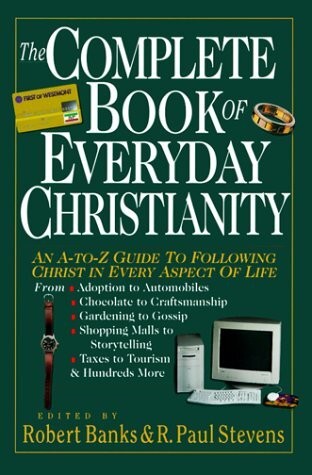
The authors Robert Banks and R. Paul Stevens have partnered with The Theology of Work Project to offer The Complete Book of Everyday Christianity in its entirety here. All rights reserved.
This resource was originally published in 1997, and the text has not been updated.